Fourche
Creek Information >
Fourche
Creek Sights >
Fourche Creek Information
Sights
Fourche’s Native Residents
You may think that because the watershed
is within the city limits that the wildlife present would
be limited. Fortunately, this is incorrect. Wildlife is surprisingly
adaptable, living in conditions never before expected. As
the warm weather continues, even more creatures will be abuzz,
migrating back north or settling here in Arkansas to rear
their young.
No, you’re not seeing a small or
juvenile Great Blue. This little guy is known as a night-heron.
There are two varieties of night heron, a black crown and
a yellow-crown. We aren’t sure which one this is because
of the tree leaves, and the fact that the two species’
habitats overlap. They cover five continents, including almost
all of North America.

It is most active at dusk and at night,
feeding in the same areas that other heron species frequent
during the day.
Turtles are another well-known inhabitant
of the Watershed. On a sunny day, up to 50 turtles can be
seen sunning themselves on logs, often pushing each other
off the log to fight for space.

The most well known, and threatened species
are the ornate box turtle and the red-eared slider turtle.
Unfortunately, their popularity as a child’s pet has
drastically reduced the wild numbers. And what’s worse,
when the child grows uninterested in the turtle, often the
turtle is set free.
These guys have no idea what wild food
looks like, and many released turtles die of starvation and
disease.

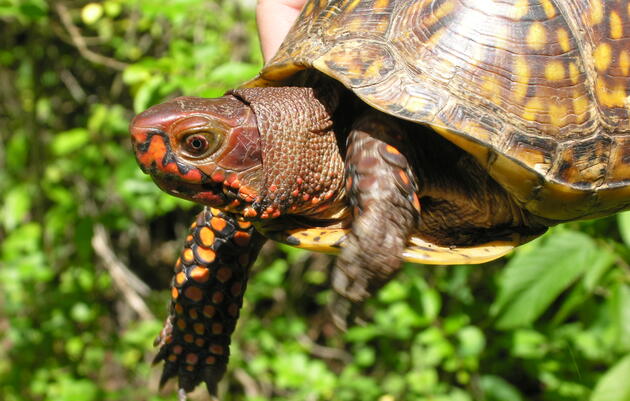
This is a female Eastern Box Turtle. We
know this is a female because she hissed at us. Only female
turtles hiss; males growl. She was actually quite ferocious,
and tried to run away in mid air.
Here is another box turtle, although we
aren’t sure of what type. We suspect Eastern, but this
was as far as it would come out of its shell while we were
anywhere close. The top of its shell was extremely pointed,
and the turtle was heavier than most. Perhaps it was a female
heavy with eggs?

Related to turtles are the various water
and land snakes we have encountered. Now that the winter hibernation
is over, the snakes are at their most deadly, with a season’s
full of venom and very hungry bellies. Please be cautious
when out in the swamp, and never attack a snake. If you leave
it a lone, it will leave you alone too.

This looks like a Water Moccasin or Cottonmouth,
but it is actually a non-venomous species known as the Diamondback
Water snake. They have evolved to resemble poisonous snakes
so other, bigger predators will leave them alone. However,
they are still very nasty, and when provoked, will take a
hunk of flesh.
Notice how he arches his neck when provoked,
and how the head itself is “diamond” shaped, closely
resembling that of a viper.
This is a much calmer Ribbon Snake. This
one has green stripes, but they come in many different colors.

Ribbon Snakes are harmless inhabitants
of local waterways. They subsist on small fish and invertebrates.
They live in burrows made in the soft bank-side mud.
This
is not a harmless water snake. This is the infamous Water
moccasin; aka the cottonmouth. They are very venomous and
quick to strike. They are easily distinguished from non-venomous
snakes by the slit eyes and the flattened, diamond-shaped
head. In the area this picture was taken, a total of three
separate snakes were seen, all very happy and well fed.
This snake will actually eat venomous
snakes, along with toads, crickets, and small rodents. This
is a speckled kingsnake, one of the easiest going snakes you
will ever meet. They usually hang out around creeks and lowland
fields.
Hopefully the next character on our list
won't become a water moccasin's dinner!
This particular toad is very well camouflaged.
The bright green striping under his chin could indicate that
he has poison in his skin, possibly making him unattractive
prey.
The Crawfish is a well known sight in
the South, and many species thrive in the Fourche Creek watershed.
We have found them very small, and we have also found them
at the large grandpappy size.
We've also photographed large fish, such
as the Spotted Gar.

The greatest indications we have found
of life are the prints and remains left behind. We are constantly
finding paw prints, bones, and droppings of a variety of creatures.
Most common are raccoon and dog prints.

This deer print was found just off of
I-440. It was quite large and deep, indicating a full-grown
buck or very large doe. There were two or three other sets
of deer tracks with it, but these were the cleanest and deepest.

These are waterfowl prints, probably from
a Crowned Heron. They were everywhere and overlapped, indicating
multiple individuals at once.
Occasionally, we do find remains. On the
left is what was originally thought to be a fox skull, but
now we are thinking dog. Skull identification in many species
is very difficult without the lower jaw and full set of canine
teeth. On the right is the upper half of a deer skull found
near Otter Creek. |