Fourche
Creek Information >
Fourche
Creek Sights >
Fourche Creek Information
Sights
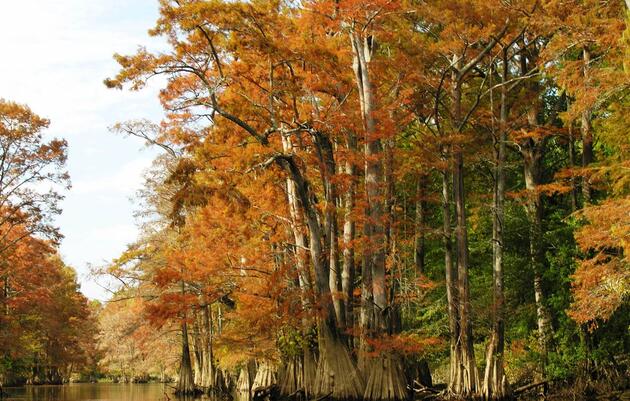
Bald Cypress Trees: Grandfathers of the Wetlands
Bald Cypress are known for their lacy,
pale-green leaves and the woody "knees" that are
commonly believed to provide oxygen to the tree's roots when
they become submerged in swampy conditions. In an unusual
attribute for needle-bearing trees, the trees lose all their
needles in the winter, thus the “bald” aspect
of their name.

The bald cypress, while not endangered,
is threatened in areas of the South and is completely gone
in places up north. This can be attributed to two major factors:
money and money.
Lumber from Bald Cypress is priced at
a premium because it is sturdy, impervious to insects, and
does not rot--which might be expected of a tree that often
spends much of its life with its roots in water. Most of the
really big Bald Cypresses were logged out across their range;
giant 500-year-old specimens with diameters of ten feet or
more were still being destroyed in the late 1970’s until
the destruction was stopped.
The fruit of the Bald Cypress is a hard,
pear-shaped cone that turns brown and becomes woody as it
matures. Not many animals can open the tough fruit, so the
vast majority of Bald Cypress cones fall to the ground beneath
the tree that produced them--exactly where a seedling has
little chance competing against its parent for sunlight in
some dimly lit swamp, although some manage to float away and
germinate on another shore.
Until
the early 1900's, there was a natural solution to the conundrum
of long-distance dissemination: the Carolina Parakeet. This
colorful dove-sized bird had a hooked bill strong enough to
open Bald Cypress cones, and it spread the trees' seeds far
and wide in its droppings.
Unfortunately, people and parakeets had
major conflicts because the birds foraged on orchards and
corn crops, so to protect their livelihood farmers systematically
destroyed local congregations of Carolina Parakeets. A sizable
number of individuals also were captured as cage-birds or
killed for feathers to adorn ladies' hats. By the mid-1850's,
John James Audubon was already reporting an alarming decline
in parakeet numbers, and in 1900 there were no more free-flying
flocks big enough to maintain the species. When the last Carolina
Parakeet died in 1914 in the Cincinnati Zoo, there were no
birds left to disseminate Bald Cypress seeds beyond the swamp.

Cypresses, for all that they’ve
got going against them, are a hardy, slow growing, resilient
tree. Here is a specimen we found not 100 yards from the interstate
and a trucking company. At one point a dock had been built
next to the tree, but over the years the root system has grown
around the structure, destroying it.

Here is another tree found just south
of Interstate Park just off of Arch Street. It was large enough
for a person to sit in, and completely surrounded by forest.
The really amazing part was that we could still hear city
traffic and people, but could not see anything. This tree
is probably around 300 years old.

As mentioned above, another distinctive
feature of the Bald Cypress is the growth of knobby “knees”
around the base of the tree. These knees can be as tall as
a man, and very large around. This group of knees was one
of the largest we have encountered.
Also, while in the area south of Interstate
Park, we came across this monster Bald Cypress; the lack of
any smaller trees near the base is evidence of how much water
and nutrients this particular tree was taking up. Johnnie,
who is six feet tall, is demonstrating just how wide this
tree is.

|